2026-05-27
Swing Check Valve (Wafer Type): A hinged disc (clapper) swings open when fluid flows forward and closes against a seat when flow reverses. Disc movement arc is 45 to 90 degrees. Body length is short: 60 to 120 mm for a 1-inch size. These valves produce a pressure drop of 0.3 to 0.8 bar at nominal flow velocity. Swing check valves are specified for horizontal pipelines carrying water, oil, or air up to 80°C. The brass body is typically cast from C83600 (85-5-5-5) or C89833 lead-free alloy.
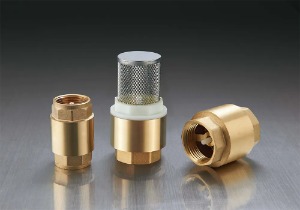
Ball Check Valve: A brass or PTFE-coated brass ball seats against a ring. Forward flow lifts the ball from the seat. Reverse flow pushes the ball back into sealing contact. Ball movement is guided by a cage (integral to the body). Ball check valves tolerate dirty fluids better than spring checks because the ball rotates and cleans its seating surface. Pressure drop is 0.1 to 0.3 bar higher than swing checks due to the ball obstruction. Common sizes: 1/2 to 2 inches. Applications include sump pumps, irrigation systems, and condensate drains.
Lift Check Valve (Piston Type): A conical or flat piston rises vertically in a guide. The piston lifts when forward pressure exceeds the weight of the piston (plus spring if fitted). Lift check valves require horizontal installation with the bonnet upward. They provide tighter sealing than swing checks because the piston mates with a metal or elastomer seat. Maximum working pressure is 25 bar for brass bodies. Used in steam lines (up to 180°C when fitted with PTFE seats) and high-pressure water systems.
Y-Strainer Check Valve Combination: A swing or spring check integrated with a removable strainer screen (mesh 20 to 100). The strainer prevents debris from fouling the seating surface. The combined unit reduces fittings compared to separate strainer and check valve. The blow-down port (plugged or valved) allows screen cleaning without removing the valve body. Common in hydraulic systems and fuel oil lines.
Wafer Check Valve (Spring-Loaded Disc): A thin (25 to 40 mm for 1-inch) disc mounted on a hinge pin with a torsion spring. The spring assists closure before flow reversal. Wafer checks are installed between two flanges. The brass body is machined from bar stock (C36000) rather than cast. These valves are used in chemical processing and marine applications where space is limited.
Valve Body and Bonnet
The body and bonnet (cover) are cast or forged from brass alloys. For general-purpose water service, C84400 (81% Cu, 9% Zn, 6% Sn, 4% Pb) is common for sand casting. Tensile strength is 220 MPa. For higher pressure (above 15 bar), forged C37700 (59% Cu, 39% Zn, 2% Pb) provides 330 MPa tensile strength and no porosity. For potable water applications subject to lead regulations, lead-free alloys are specified. C89833 (86% Cu, 9% Zn, 4.5% Sn, 0.2% Pb maximum) meets NSF/ANSI 61 standards. For dezincification-resistant (DZR) requirements, C35200 (63% Cu, 1% Sn, 0.1% As, balance Zn) is used. The arsenic addition inhibits zinc leaching. DZR brass is required for water with chloride levels above 250 ppm or temperatures above 60°C.
Disc and Poppet Materials
The moving component (disc, poppet, ball, or piston) contacts the seat to seal flow. For general service, the disc is brass (C36000) with a captive nitrile rubber (NBR) seal. NBR hardness is Shore A 70 to 80. Temperature range: -30°C to 100°C. For hot water above 80°C or steam up to 180°C, EPDM rubber (ethylene propylene) or PTFE (polytetrafluoroethylene) seals are used. PTFE has temperature range -200°C to 260°C but requires higher seating force (2 to 3 times NBR) to deform and seal. For chemical resistance to oils and fuels, fluorocarbon rubber (FKM, Viton) is specified. FKM resists swelling in hydrocarbon fluids but degrades in steam above 150°C. Ball check valves use solid brass balls (C36000) with density of 8.5 g/cm³ or hollow PTFE balls for reduced weight and faster response.
Spring Materials (If Applicable)
Spring-loaded checks use stainless steel springs. Type 302 stainless (AISI 302) is common: composition 0.15% C, 18% Cr, 8% Ni. Tensile strength of spring wire is 1,500 to 1,800 MPa. For aggressive fluids (saltwater, acids), alloy 316 stainless (2-3% Mo) provides pitting resistance. Spring rate (stiffness) determines cracking pressure. A 0.05 bar spring allows gravity-driven flow but may not seal against small reverse pressure differentials. A 1.5 bar spring seals tightly but requires significant forward pressure to open. Spring ends are ground flat to prevent localized stress. Spring life exceeds 500,000 cycles under normal operation.
Copyright © Zhejiang Jiafu HVAC Co., Ltd. All Rights Reserved.


 English
 русский