2026-04-03
Before examining the specific types, it is useful to understand what all brass check valves share. The body of the valve is typically forged or cast from a brass alloy, such as C36000 (free-machining brass) or C84400 (a common valve bronze). This material offers sufficient strength for moderate pressures and temperatures encountered in residential and commercial plumbing, while resisting the dezincification corrosion that can affect some brasses in certain water conditions.
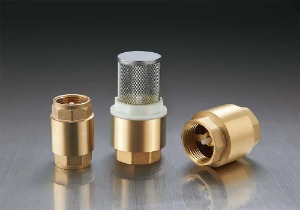
All check valves have an inlet and an outlet port, and all contain some form of closing element—a disc, ball, or flap—that is acted upon by the fluid. When flow moves in the intended forward direction, the pressure of the fluid pushes the closing element open, allowing passage. When forward flow stops or reverses, the closing element returns to its seat, sealing the opening and blocking reverse flow. The method by which this closing element operates defines the valve type.
Swivel Check Valves
The swivel check valve, sometimes referred to as a swing check valve in smaller brass configurations, employs a design where the closing disc is hinged or mounted on a pivot pin. In this configuration, the disc is free to rotate or swivel away from the seat when flow is in the forward direction. Imagine a small door mounted on a hinge; as water flows through, it pushes the door open and swings it out of the way. When flow ceases or reverses, gravity and the reverse flow pressure cause the disc to swing back into contact with the seat, creating a seal.
One of the primary characteristics of the swivel check valve is its relatively low resistance to flow when fully open. Because the disc swings completely out of the flow path, the pressure drop across the valve—the amount of energy lost as fluid passes through—is generally low. This makes swivel checks suitable for applications where maintaining flow efficiency is important. However, there are considerations for their use. Swivel check valves typically require the disc to be positioned horizontally or with the hinge pin oriented vertically to allow gravity to assist in closing. If installed in a vertical line with flow upward, the disc may not close reliably when flow stops, as there is no gravity force pulling it back to the seat. Additionally, when forward flow stops suddenly, the disc can swing back and slam against the seat, potentially causing water hammer—a pressure surge that can generate noise and stress system components. For this reason, some swivel check designs incorporate weighted levers or dashpots to control the closing speed.
Lift Check Valves
The lift check valve operates on a different principle. In this design, the disc is not hinged but is instead guided to move linearly within the valve body. When flow is in the forward direction, the fluid pressure lifts the disc off its seat, allowing passage. The disc rises vertically (or at an angle, depending on the design) within a guided chamber. When forward flow diminishes or reverses, gravity and backflow pressure cause the disc to lower back onto the seat, sealing the valve.
Lift check valves are often compared to globe valves in terms of their internal geometry. The flow path through a lift check makes several turns, which inherently creates more resistance than a straight-through swing check design. Consequently, the pressure drop across a lift check valve is typically higher. However, this design offers advantages in certain installations. Because the disc moves in a guided path, lift check valves can be installed in either horizontal or vertical lines (with flow upward), as the disc is guided and does not rely solely on gravity to return to the seat in the same way a simple swing check does. The guided disc also allows for a more controlled seating action, which can reduce slamming in some applications. Lift check valves are commonly found in smaller line sizes and in applications where the flow is intermittent or where a tight seal is required, as the disc-to-seat contact can be precisely aligned.
Tilt Disc Check Valves
The tilt disc check valve represents a design that attempts to combine the low-pressure drop of a swing check with the stability and reduced slamming of a lift check. In this configuration, the disc is mounted on a hinge or pivot point that is offset from the centerline of the disc itself. The disc does not swing completely out of the flow path like a door; instead, it tilts or rotates to a partially open position.
When flow is in the forward direction, the pressure acts on the disc, causing it to tilt open. The fluid passes around the disc, which remains partially in the flow stream. This design results in a streamlined flow path with a pressure drop that is often lower than a conventional swing check. More significantly, the tilting action allows the disc to travel a shorter distance to reach the seat. When forward flow stops, the disc has less distance to travel and can close more quickly, often before significant reverse flow can develop. This rapid closing action is effective at preventing water hammer and the pressure surges associated with it. The tilt disc design is also guided, providing more stable operation in turbulent flow conditions. While less common in very small, simple brass valves than the swivel or lift types, tilt disc designs are found in more engineered brass valves for commercial and light industrial applications where flow conditions are demanding.
Silenced Check Valves
The silenced check valve, sometimes marketed as a noiseless or quiet check valve, is a variation designed specifically to address the issue of water hammer and the associated noise of valve closure. While the term "silenced" might suggest a complete absence of sound, these valves are engineered to minimize the noise generated during the closing cycle, which is a common concern in residential and commercial buildings where pipe noise can be disruptive.
The silencing function is typically achieved through one of several mechanical means. Some designs use a spring-assisted closure. A spring of calibrated force gently pushes the disc toward the seat. As forward flow diminishes, the spring begins to close the disc progressively, rather than allowing it to slam shut under the force of reverse flow alone. The spring controls the closing speed, ensuring that the disc meets the seat softly. Other silenced check valves employ a dampening mechanism. This might involve a piston or diaphragm that moves through a fluid or air-filled chamber, using hydraulic or pneumatic resistance to slow the disc's final movement. This is analogous to a door closer that prevents a door from slamming.
The internal configuration of a silenced check valve can be based on a lift or a tilting disc, but with the added control element. The primary application for these valves is in systems with pumps that cycle on and off, or in tall buildings where the static pressure head can cause rapid reverse flow. By mitigating water hammer, silenced check valves protect piping joints, hangers, and connected equipment from stress, while also contributing to a quieter environment. They are commonly installed on the discharge side of circulating pumps in domestic water and heating systems.
Choosing among these types of brass check valves requires matching the valve's operational characteristics to the system's demands. For applications with continuous flow and minimal concern for slamming, such as in some gravity-fed drainage or transfer lines, a simple swivel check valve may be adequate due to its low pressure drop. For systems with vertical piping runs or where a more guided closure is desired, a lift check valve is often the suitable choice. In situations where pumps start and stop frequently, creating a risk of water hammer, a tilt disc or a spring-assisted silenced check valve provides the necessary control. Other factors influencing selection include the required pressure rating, the temperature of the fluid, the space available for installation, and the chemical compatibility of the brass with the fluid medium. By understanding the mechanics of how each type functions—whether the disc swivels, lifts, tilts, or is spring-controlled—one can make an informed decision that ensures reliable, long-term protection against the problems of backflow.
Copyright © Zhejiang Jiafu HVAC Co., Ltd. All Rights Reserved.


 English
 русский